
Alzheimer’s Clinical Trial Based on Precision Medicine Helps Nearly All Patients Recover
By Alzheimer’s Survivors, May 2026
A successful Alzheimer’s clinical trial — based on precision medicine and approved by a review board under U.S. government oversight — has now been completed.
According to Apollo Health, it is “the first such trial in which contributors such as biotoxins, oral microbiome, and tick-borne illnesses have been sought and, when identified, treated.”
Remarkably, nearly all patients in the precision-medicine group improved on key cognitive measures. And the statistical confidence level of the most important metric is a very high 99.9%.
The results of the trial have already been posted as a preprint, while the scientific paper is currently undergoing peer review. But as Alzheimer’s survivors ourselves — living full lives today thanks to the precision medicine approach used in the clinical trial — we believe the big story of this trial is not going to change in substance.
It’s a story that needs to be shared now. So, in this report, we walk you through one of the key charts from the study. The chart tracks what’s called the “neurocognitive index,” which provides a single overall score of brain performance — combining memory, attention, speed, and thinking skills.
For the population as a whole (mostly individuals without Alzheimer’s), the average score is 100, adjusted by age. But since all patients in the trial had mild cognitive impairment or early Alzheimer’s, they began with a score below 100.
Patients in the test group were treated with precision medicine. This means that they underwent a series of tests to determine the particular factors most likely to be playing a role in their cognitive decline. That mix of factors varies from person to person. So, each patient received customized treatment targeted to correct his or her causes of cognitive decline.
Patients in the control group received the standard of care — the protocol widely prescribed by neurologists and the medical profession.
Averaging and comparing the scores of each group produced the following results:
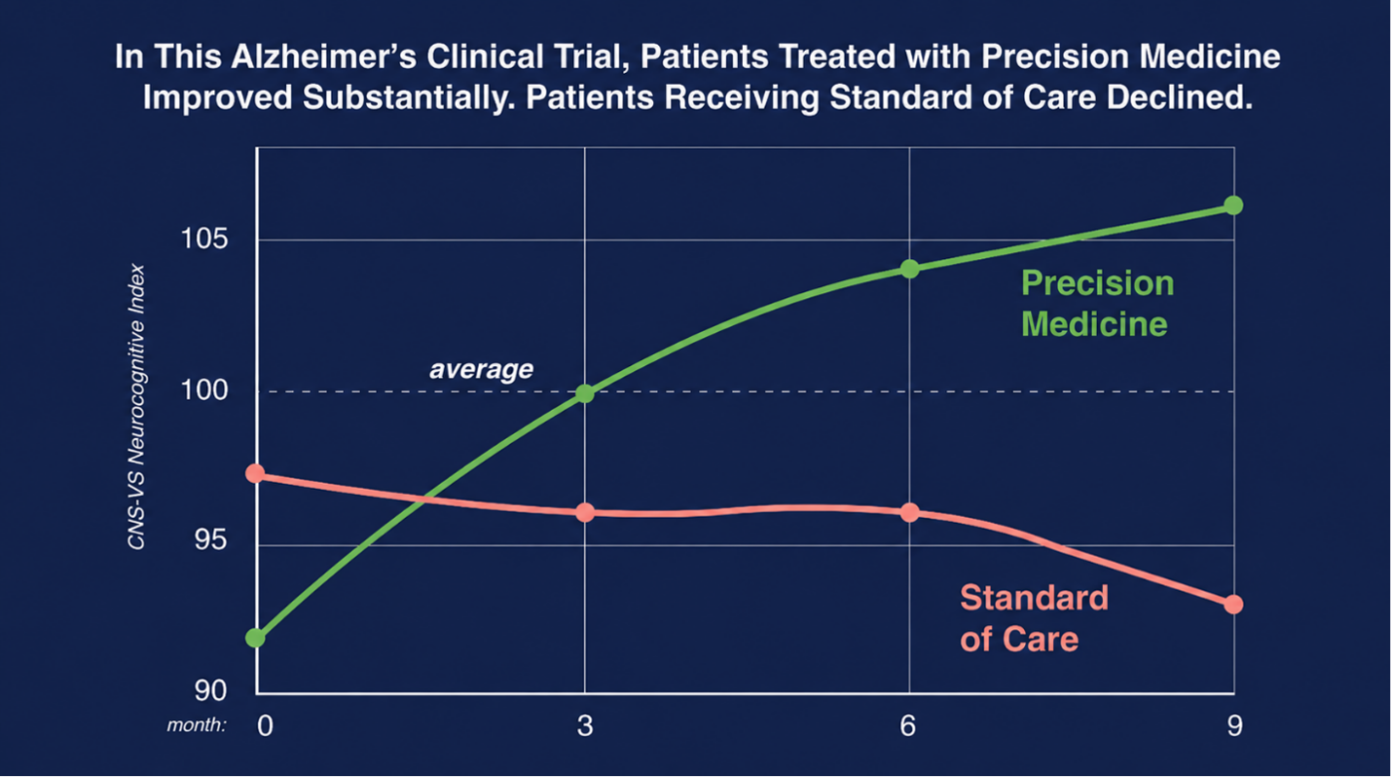
Patients treated with precision medicine rose from a neurocognitive index of 92 to 106. Even though they started the trial with below-average cognition, by the end of the trial, they scored at a cognitive level that was well above average. This is the opposite of the normal clinical outcome for such patients.
Sadly, patients treated with standard of care got worse. On average, their score fell from 97 to 92.
Here’s another way of looking at the numbers: At the start of the trial, the average score of patients treated with precision medicine was 5 points lower than the score of those receiving standard of care. By the end of the trial, the average score of patients treated with precision medicine was 14 points higher than the score of those receiving standard of care. That’s a very significant 19-point swing.
How certain can we be that this result is statistically significant? The answer is given by what’s called the “p-value.” Here’s how that works:
- For trial results to be widely accepted, the possibility that the observed changes happened by chance can be no greater than 50 out of 1,000. (That’s a maximum p-value of 0.05.)
- By contrast, in this trial, the possibility that the observed changes happened by chance was less than 1 out of 1,000 (a p-value under 0.001).
Thus, the confidence level in this all-important index was many times greater than that of other medical trials that meet the minimum standards.
It represents a complete reversal of what Alzheimer’s patients have always been told to expect, even when diagnosed at an early stage. They are told to arrange their affairs and prepare for an inevitable decline. For most patients, it’s a diagnosis without hope.
Nevertheless, for Alzheimer’s survivors like us, the results are not surprising. They reflect what we’ve experienced ourselves. What’s so exciting now is seeing this demonstrated in a randomized controlled trial approved by the Institutional Review Board (IRB).
The IRB reviews and approves clinical trials involving humans to help ensure they are ethical and safe. The approval is required under federal regulations issued by agencies like the U.S. Department of Health and Human Services (HHS), and trials are conducted under oversight from federal offices like the Office for Human Research Protections (OHRP).
We believe this kind of recognition could help pave the way for broader insurance coverage of precision medicine approaches. That would not only be a real benefit for patients, but it could also help deliver significant savings to health insurance companies, which currently must cover Alzheimer’s treatment and memory care for the remainder of patients’ lives. Recovery from the disease would be a better outcome for everyone — patients, doctors, and insurers.
This precision-medicine trial does not claim to provide all the answers. But it provides the most encouraging evidence to date that a personalized, precision medicine approach can significantly improve the condition of patients with cognitive impairment and early-stage Alzheimer’s. We have no doubt these results deserve serious attention, replication, and broader discussion.
Our mission is to spread the word that recovery from the disease is possible. We have little doubt that this Alzheimer’s clinical trial will go a long way toward advancing that all-important mission.